

Many innovative projects begin with a technological solution: a new product, prototype, software, method, material, production process, or scientific result that can be applied in practice.
But when European funding, venture capital or partnerships with the industry are sought, technological development alone is rarely enough.
Evaluators and investors usually want to understand not only whether the solution is technically feasible, but also whether there is a real need for it, who will use it, who will pay for it, how it will be implemented, how it will be maintained, whether the organization has the capacity to develop it and last but not least – how the public will accept it. This is where the various „“readiness levels” – readiness levels.
The most familiar concept is TRL – level of technological readiness. But other frameworks are increasingly being used around it as well.: BRL – level of business readiness, MRL – level of market readiness и IRL – level of investment readiness. They do not replace TRL, but complement it.
Why TRL is not enough
TRL shows how far a technology has developed – from an early scientific idea to a solution proven in real conditions. This is very important in research programs, innovation and technological development, especially in Horizon Europe and other European instruments.
But TRL does not answer all the questions. A technology may be demonstrated successfully, but still lack a clear market, viable customers, a working business model, a sales strategy, or an organization ready to implement it. Conversely, it is also possible that the market has a strong need for a solution, but the technology is not yet mature enough.
Therefore, when preparing a project, it is useful to think not only about technological readiness, but also about business, market, and investment readiness.
TRL: Is the technology ready?
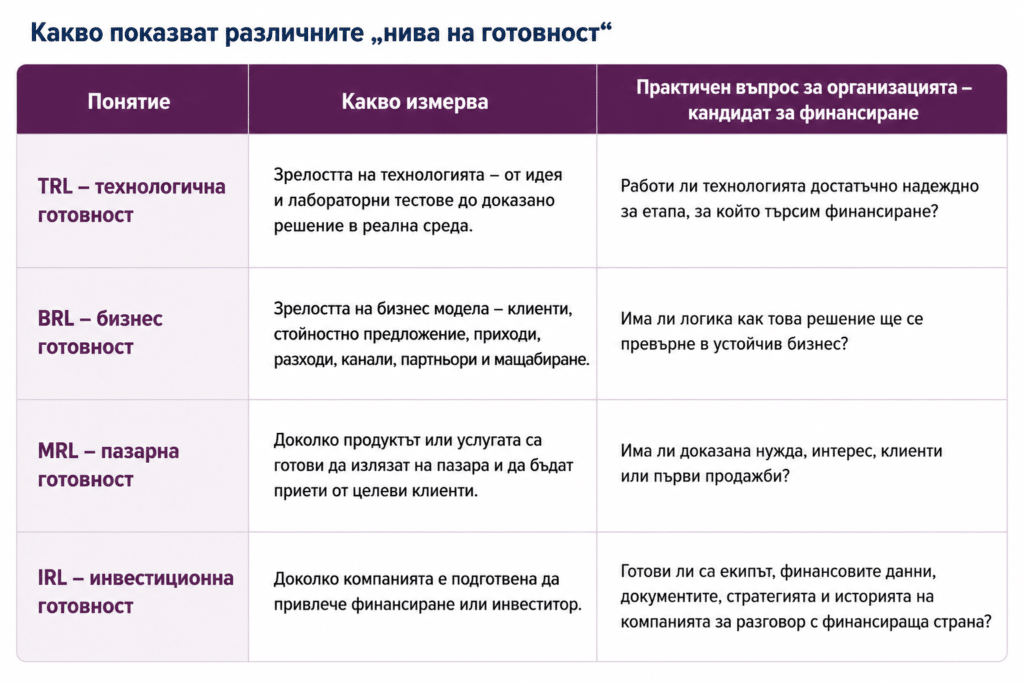
The Technology Readiness Level (TRL) is a scale from 1 to 9 that indicates how developed and tested a technology is. Low levels are associated with a scientific idea and proof of concept, medium levels with validation and demonstration in a laboratory or relevant environment, and high levels with a ready system proven in real-world conditions.
In European programs TRL is often used to determine what types of projects are eligible. Some calls seek early research results, others – demonstrations, pilots or solutions close to the market. Therefore, it is important that the applicant does not specify TRL mechanically, but can justify why the technology is at a given level and what will change by the end of the project.
BRL: Is the business model ready?
The Business Readiness Level (BRL) looks at not the technology itself, but the business logic surrounding it. Does it have a clear customer? What problem is being solved? Who pays? How will revenue be generated? What are the costs? Does the solution have a competitive advantage? Can the solution be scaled up?
BRL is particularly useful for scientific teams, startups, and technology companies that have good development but have not yet turned that development into a sustainable business model. With European funding, this is often evident in the parts related to exploitation, business plan, market strategy, commercialization, post-project sustainability, and expected impact.
MRL: Is the market and the product ready for real use?
The Market Readiness Level (MRL) shows how prepared the solution is for a real market. The focus here is on customer segments, validated need, readiness for payment, early adopters, pilot customers, feedback from the market, and evidence that the solution can be accepted.
A company may have a good prototype, but if it hasn’t talked to customers, tested the price, doesn’t know who makes the buying decision, or has no evidence of real interest, its market readiness remains low.
IRL: Is the company ready for funding?
The Investment Readiness Level (IRL) is related to the company’s readiness to attract external financing – a grant, a loan, venture capital or another financial instrument. This includes financial data, ownership structure, management capacity, legal documents, rights to the product or technology, a financial model, an investment presentation, and clarity about the next steps.
For investors and some European programs, this is critical. The idea may be good, but if the company does not have prepared documents, realistic financial assumptions, a clear distribution of ownership, or the capacity to execute, the risk for the funding party is higher.
AND ANOTHER IMPORTANT THING: Is the environment ready to accept the innovation?
In projects funded with public resources, an additional indicator is increasingly being added to the familiar levels of readiness – Societal Readiness Level (SRL) – level of public readiness. It asks whether a given technology, product, process or project is aligned with the needs, expectations and concerns of consumers, society and other stakeholders.
SRL answers questions such as:
- Which groups will be affected by the decision?
- Have their needs, fears or objections been understood?
- Is there a risk that the technology will be rejected, even if it is technically working?
- Are users, communities, institutions, experts, or other stakeholders involved in the development and testing?
- Are there measures in place for communication, acceptance, training, accessibility, or reducing negative effects?
SRL is particularly important in projects that affect people, the urban environment, mobility, energy, climate, health, education, security, artificial intelligence, public services, or changes in the way businesses and communities operate. With such projects, funding institutions increasingly expect not only a technological solution but also evidence that it can be understood, adopted, and applied in a real-world context.
Practical self-check before applying
Before choosing a program or starting project preparation, it is useful for the organization to answer several questions:
- What is the actual technological level of the solution, and with what evidence can we demonstrate it?
- What will be achieved by the end of the project – a prototype, demonstration, pilot, market deployment, or scaling up?
- Is there a clearly defined customer and a problem that the solution solves?
- Are there any evidence of market interest – conversations with customers, pilots, contracts, letters of interest, first revenue or active usage?
- Is the business model clear – who pays, for what, when and at what price?
- Is there a realistic plan for commercialization, partnerships, sales channels, and growth?
- Is the company prepared for an audit by a funding party – financial data, ownership, contracts, intellectual property, team and capacity?
- If an investor is being sought, is it clear what kind of capital is needed, what it will be used for, and what growth can be achieved?
How to use these concepts correctly in the design documentation
Readiness levels should not be used as a „decoration“ in the project proposal. If the candidate indicates a high TRL, BRL or MRL, they must be able to prove it with concrete facts – tests, prototypes, customers, sales, market data, partnerships, financial models or other verifiable results.
The readiness levels should be considered together. For example, the technology may be at TRL 6 but the business model is still at an early stage. Or there may be a strong market need, but the technology needs additional validation. It is these discrepancies that often indicate what type of funding is appropriate – a research project, a demonstration project, an accelerator, advisory support, a grant, a loan, or venture capital.
IMPORTANT! Different programs may use readiness levels in different ways. The specific conditions of the respective invitation must always be checked.
***
In short:
- TRL Question: Does the technology work?
- BRL Question: Is there a viable business model?
- MRL Question: can the solution be produced or implemented reliably?
- IRL Question: Are the individual elements integrated into a working system?
- SRL Question: Will the solution be accepted and used by the people, organizations, or the environment for which it is intended?
Therefore, when preparing a funding proposal, it is no longer sufficient to simply demonstrate that the technology is innovative. It is increasingly important to show why it is needed, for whom it creates value, what risks or concerns it may cause, and how the project will work with these groups from the development and testing stage onwards.