



Bulgaria is preparing a change in its regional zoning, which is not just an administrative issue.
The proposal for a new distribution of planning areas at the level NUTS 2 It will be important for the way the country plans and justifies European funding after 2027 – especially for regional priorities, integrated territorial investments, the map of state aid, and the future allocation of resources under the Cohesion Policy.
The project has been published for public discussion. Interested parties may submit their opinions through the Public Consultation Portal until August 6, 2026. The materials are available here.
What is changing?
With the proposed changes to the Regional Development Act, the current six planning regions from the so-called NUTS 2 level are replaced by four larger regions.
It is important to emphasize that this does not change the administrative boundaries of the regions and municipalities. No new regions are created, no municipalities are closed down, and the administrative-territorial structure of the country is not changed. Only the statistical and planning framework is being changed, which is used for regional policy, strategic planning, and European funding.
Which are the new regions?
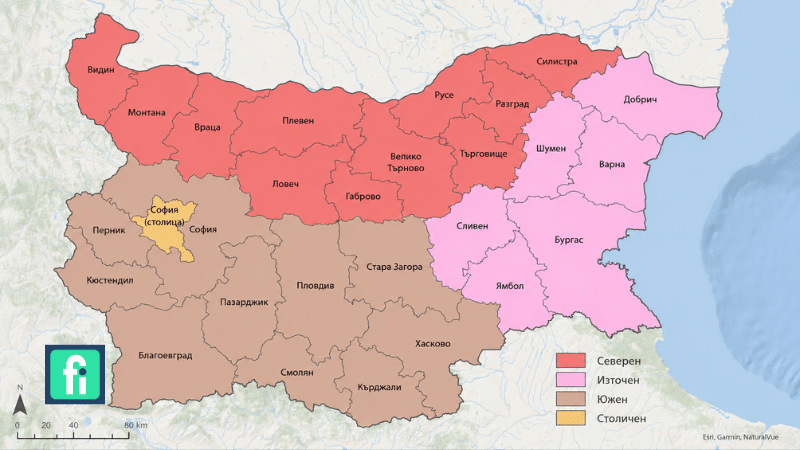
The proposal provides for four levels of districts NUTS 2: Northern, Eastern, Southern and Capital District.
Northern area: Vidin, Montana, Vratsa, Lovech, Pleven, Gabrovo, Veliko Tarnovo, Targovishte, Ruse, Razgrad and Silistra;
Eastern region: Dobrich, Varna, Shumen, Burgas, Sliven and Yambol;
Southern area: Sofia region, Pernik, Kyustendil, Blagoevgrad, Pazardzhik, Smolyan, Plovdiv, Stara Zagora, Haskovo and Kardzhali;
Capital district: The territory of the Sofia Municipality.
What is different about the current map?
Currently, Bulgaria is divided into six levels of region. NUTS 2: Northwest, Northern Central, Northeast, Southeast, Southern Central and Southwest.
The new model not only reduces the number of regions from six to four, but also changes the way individual regions will be statistically grouped.
- Northwest and Northern Central Region They are united into a larger Northern region, to which the Târgovişte region is also included.
- The Eastern Region It unites part of the current North-Eastern region and part of the South-Eastern region, but without Targovishte and without Stara Zagora.
- The Southern Region it becomes a very wide region that includes parts of the current Southwestern, Southern Central and Southeast regions.
- Sofia is separated into a separate entity Capital district.
The most significant change is precisely the removal of Sofia from the general statistics of the Southwestern region. This is important because the capital has significantly higher economic indicators than the neighboring regions and has thus influenced the average values for the entire region until now.
What changes with the separation of Sofia?
The key issue is the removal of Sofia from the current South-Western region, which also includes the Sofia region, Pernik, Kyustendil and Blagoevgrad.
The significantly higher economic indicators of the capital increase the average values for the entire region and do not fully reflect the differences in development of the other regions.
Since the EU’s Cohesion Policy uses NUTS 2-level indicators, including GDP per capita compared to the EU average, to categorize the regions and target resources, the separation of Sofia will provide a more realistic statistical picture of the neighboring territories.
Pernik, Kustendil, Sofia region и Blagoevgrad They are moving to the new Southern Region. This will certainly change the statistical basis on which future investments and regional priorities will be planned. The change does not automatically mean more funds for a specific region or municipality, but it creates a different framework for analysis, strategies, and funding after 2027.
The Southern District also extends to Stara Zagora – one of the key energy and industrial regions of the country.
Thus, in one region at the NUTS 2 level, Stara Zagora, Pernik and Kyustendil fall – the so-called „coal regions“– territories related to the energy transition, industrial transformation, new jobs and attracting investment. This will be relevant in future measures to A fair transition, decarbonization, energy efficiency, skills and regional economic development.
What is the connection with European funding?
NUTS 2 regions are the basic territorial unit on which the European Commission and the Member States analyze regional development. They are not the only criterion for funding, but they are an important basis for planning, statistics, and comparisons between regions.
The new zoning will be relevant for:
- the development of the programs and strategic documents after 2027;
- the determination of regional priorities and investment needs;
- the planning of integrated territorial investments;
- the argument for support for less developed or transforming regions;
- the regional map of state aid and the eligible aid intensities when a specific scheme is linked to regional aid;
- allocating future resources towards infrastructure, industrial transformation, innovation, skills, green and digital transformation.
Will the current 2021-2027 programs change?
Automatic changes to the procedures already in place for the 2021-2027 programmes should not be expected. The bill is related to the implementation of the new European NUTS classification from January 1, 2027, and to the preparation of the strategic framework for the next period.
The real impact will be more important for the period after 2027, when the new programming documents, regional strategies, investment priorities and funding rules will be developed.
How will it affect integrated territorial investments?
The new zoning will require the adaptation of the system of strategic documents. Integrated territorial development strategies will be developed for the Northern, Eastern and Southern districts. A special approach is envisaged for the Capital District – the Plan for the Integrated Development of the Capital Municipality will also fulfill the functions of an integrated territorial development strategy for the region.
This is important because regional strategies and regional councils play a role in determining priority integrated territorial investments. For municipalities, universities, scientific organizations, business associations, non-governmental organizations and companies, this means that project ideas should be conceived within the new regional logic.
What does this mean for business?
For businesses, the new zoning may have several implications.
First, regional indicators can influence the eligibility intensity on support under schemes that use Regional aid иThey are aimed at less developed territories.
Secondly, future programs can focus more resources on specific regional priorities – industrial transformation, energy efficiency, decarbonization, digitalization, innovation, skills, or investments in economic zones.
Thirdly, businesses in areas that will no longer be statistically linked to Sofia may find themselves in a different context under future programs. This will depend on the specific rules for the period after 2027, but it is important to monitor this at the planning stage.
What is the significance for the municipalities?
For municipalities, the topic is directly related to future planning. The new districts will be the framework within which regional strategies will be developed and part of future territorial investments.
It will be important for the municipalities:
- in which new area they fall;
- what priorities will be set for the respective region;
- how their project ideas fit into the new territorial logic;
- how they will participate in the processes of regional planning;
- How the future lists of priority integrated territorial investments will be formed.
What is changing for Sofia?
Sofia is being separated as a separate Capital District. This will allow the capital to be considered separately from the rest of the current Southwestern District. Statistically, this is more correct because Sofia has a different concentration of population, economic activity, infrastructure, investments, and administrative functions.
The division of Sofia also means a specific approach to strategic planning. The plan for the integrated development of the Sofia Municipality will have a dual function – it will serve as both an municipal document and a document that fulfills the role of an integrated territorial strategy for the Sofia district.
For businesses and organizations in Sofia, this means that the capital's future priorities will be planned within a separate regional framework. At the same time, Sofia's connections with the surrounding regions, including labor mobility, transportation, industrial zones, education and innovation, remain important for real regional development.
***
In summary: what to watch for Interested parties?
The new regionalization will not automatically solve regional imbalances. However, it changes the framework within which these imbalances will be measured, analyzed, and funded.
For the potential ones Beneficiaries There are three important questions:
1. How will the new integrated territorial strategies be developed?
They will outline some of the future regional priorities for the period after 2027 and will be relevant for projects that can be supported through a territorial approach.
2. How will the individual areas be positioned in the new regions?
This is especially important for Pernik, Kyustendil, Sofia region, Stara Zagora and other territories, whose statistical and strategic context is changing.
3. What will be the funding rules after 2027?
The categorization of the regions, the aid intensities and the eligibility under some of the future programs will depend on the European and national framework for the next programming period.