



When an innovative company is seeking capital, the question is not just „how much money do we need“.
The investor first is interested in what stage the business is at, what has already been verified and proven, and what needs to be achieved with the next funding.
Therefore, concepts like pre-seed, seed и Series A They are not just foreign words from the startup environment; they are practically oriented on what type of capital is suitable, to whom to turn and what evidence you need to prepare.
This article is aimed at founders of startups and innovative companies that are developing a new product, technology, or business model and are considering external funding – through investors, accelerators, corporate programs, grants, or a combination of several sources.
Why it is important to know at what stage you are
The so-called „round“Financing helps to understand how far a company has come and what more it needs to prove to become more attractive to future investors, customers or partners. In early stages, investors take more risk and focus primarily on the team, the problem and the potential. In later stages, they expect real customers, revenue, a repeatable sales model and a clear opportunity for scaling.
For business, this has very practical significance. If the company is looking for seed or Series A Financing is available, but there is still no working product or first customers; the conversation with the investors will most likely be difficult.
Conversely, if there are already paid pilots, growing revenue and a clear market niche, there is no need to present it as an idea „at a very early stage“.
What exactly is a „round“ of financing
A round is a stage in which a company raises capital for a specific next phase of its development. Typically, this is an investment in exchange for a share, a convertible instrument, or another mechanism agreed upon with the investors.
With grants, the logic is different because they usually do not require the transfer of shares, but they can perform a similar function – helping the company reach the next important stage.
The best question is not „what round do we want to attract,“ but „what should we prove with this money.“ This could be that the technology works, that customers have a real need, that they are willing to pay, that the regulatory requirements can be met, or that the model can be scaled up. These unknowns are the „risks“ that funding must help reduce – for both the company and the future investors.
Common map of the stages
The ranges below are indicative for the European market. The actual amounts depend on the sector, the country, the maturity of the company, the need for capital and the interest of the investors.
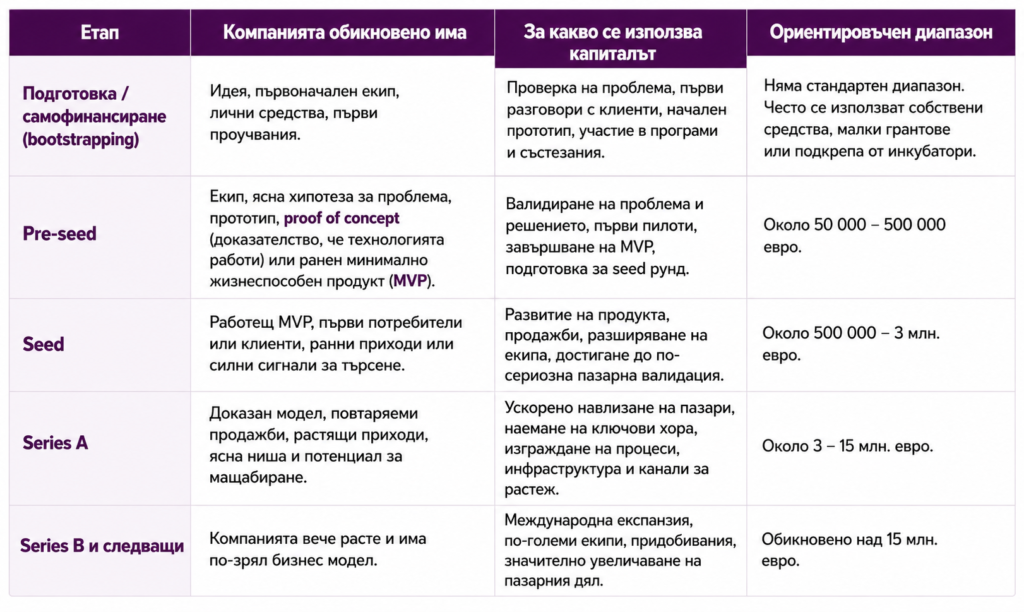
Pre-seed: the earliest formal stage
Pre-seed It is the stage where the company is still proving its key hypotheses. There may be a prototype, technological proof, a first pilot, or a minimally viable product, but there usually isn’t enough customers and revenue to demonstrate a stable business model.
At this stage, investors rarely can rely on financial indicators. Therefore, they look at the team, the clarity of the problem, the potential of the market, and the first signs that the solution makes sense. Often, the capital comes from angel investors., pre-seed funds, accelerators, corporate programs, innovation schemes, or a combination with grant funding.
Pre-seed funding is appropriate when the goal is to reach a next demonstrable result – for example, a working product. MVP, A pilot solution with a real client, technological validation, a first contract or enough strong data to start seed round.
Appropriate sources of funding at this stage include own funds, angel investors, accelerators and incubators, small grants, innovation vouchers, or corporate programs. It is important to carefully assess the conditions, especially if the program includes a stake, technology rights, or exclusivity to a specific partner.
What you need to prepare at the pre-seed stage
- A brief and clear description of the problem: who has it, how significant it is, and why the current solutions are not enough.
- Evidence that the team can implement the idea – technically, market-wise and organizationally.
- A prototype, proof of concept (proof that the technology works), or at least a concrete plan to reach the MVP.
- First conversations with clients, letters of interest, pilot partnerships or other signals from the market.
- 12-18 month plan: what will be achieved with the funding and how it will prepare the company for the next stage.
Seed: the stage at which there must already be evidence
Seed Funding comes when the company is no longer just an idea. It has a working product or MVP, First users, first customers, pilots or initial revenues.
The main question is no longer „can this be done?“, but „is there a real market and can the business model be developed?“.
At seed The stage when investors start looking for clearer evidence: whether customers are using the product, whether they are willing to pay, what the costs are to attract a customer, what the initial revenues look like, and whether the solution can be sold more than once in a similar model.
Seed Capital is usually used to expand the team, develop the product, first more systematic sales, marketing, certification, regulatory preparation, or expand the pilots into real commercial contracts.
At this stage, ordinary ones are usually suitable. seed venture capital funds, angel investors with greater capacity, accelerators with an investment component, corporate investors, or pilot implementation programs. Grants can also be useful, especially when funding development, testing, certification, or demonstration, but investors will also expect real market signals.
What investors look for in a seed stage company
- Signals for the so-called „product-market fit“: retention of users, repeat orders, paid pilots, real use of the product.
- First economic indicators: cost of acquiring a client, margins, contract size, payback period.
- Scalability: can the solution be sold to more customers without having to build it from scratch every time?.
- Market moment: growing sector, regulatory change, new requirements, or strong pressure on customers to seek such a solution.
- Team and execution: the ability not only to develop a product but also to sell it, service it and grow the business.
Series A: funding for scaling up
Series A It is the first major institutional round for many companies. Until now, investors have expected the business to have already proven that it has a working model. The focus shifts from finding the right product to rapid and controlled scaling.
The company must be able to demonstrate not only revenue, but repeatability—for example, stable growth, a clear group of potential deals and customers in the process of negotiation, strong contracts, a good retention rate, a clear sales strategy, and a team capable of managing a larger organization.
Series A Capital is often used to enter new markets, build a sales team, develop partner channels, technological infrastructure, key management positions, and prepare for the next stage of growth.
At Series A Stage funds typically invest in venture capital with a focus on growth, larger institutional investors, corporate investors, or specialized funds in a specific sector. Grants can remain a complementary instrument for research and development activities, demonstrations, or international partnerships, but the primary private capital is now focused on rapid growth, sales, and entry into new markets.
What should be clearer in Series A
- How the company generates revenue and for whatabout the model can grow.
- What are the key metrics – monthly growth, annual or monthly recurring revenue in subscription software models (ARR/MRR in SaaS models), committed future deals, customer churn, margins, and costs of acquiring customers?.
- What protects it from competition – technology, data, patents, network effects, specialized know-how, or strong partnerships?.
- What is the plan for the next 18-24 months and how will this round lead to the next significant step?.
- What does the management look like: finances, accountability, legal structure, ownership, contracts, key people.
Where grants and public funding fit in
Grants are particularly important for European startups because they can fund activities that are difficult to cover solely with revenue or private capital – research and development activities, prototyping, testing, demonstrations, certification, pilot implementations, protection of intellectual property or first international partnerships.
The main difference is that the funding organization in this case usually does not require ownership from the founders, while the equity investment changes the company's capital structure. This makes grants very useful for reducing technological or market risk, but they do not automatically replace market validation. The investor will still ask: are there any customers, who pays, how often, at what margin and can this be scaled up?.
The practically best approach is often a combination of both. With grants, development, piloting or demonstration can be funded, while with private capital sales, team, international expansion and the next stage of growth can be funded. It is important for companies to know at the very beginning which expense is eligible for a grant, which expense is eligible for an investor, and which expense should be covered by their own revenues.
For pre-seed Companies often use grants as a way to develop a prototype., MVP or a pilot without early release of ownership. seed Companies can support the further development, certification or initial demonstrations with customers. Series A And in later stages, grants are more often a complementary instrument – for example, for R&D, international partnerships, industrial demonstrations, or green and digital transformation.
***
Practical example: how a company goes through the stages
Let's assume that a Bulgarian company develops software for optimizing energy consumption in manufacturing enterprises.
At the beginning, the team has an idea, technical expertise, and talks with several potential clients. A combination of own funds, a small grant, an accelerator, or an angel investor is suitable to build the first prototype.
At pre-seed The company already has a working prototype and a pilot with one enterprise. The goal of the funding is to prove that the solution actually reduces costs and can be implemented with more than one client.
At seed The stage has several paid pilots or first contracts. The funds are used for product development, sales, technical support, certification, and team building.
At Series A The company can now demonstrate a repeatable model – for example, customers across several sectors, growing revenue, a clear pricing strategy, and a proven implementation process. The financing is now available to scale into new markets and accelerate growth.
Practically a check-list before seeking funding
- Determine what you need to prove: technology, market, regulations, sales, production, or scaling
- Describe the specific milestone you need to achieve with the funding: MVP, Pilot, first revenue, 10 clients, certification, international market.
- Calculate how much funds are needed and for how many months they will be sufficient. Investors think not only in terms of the budget, but also in the period during which the company will be able to operate until the next important milestone or the next round of funding.
- Prepare a short presentation for investors (pitch deck), a financial model, a cap table, a product description, market logic, and data on current developments.
- Seek information and advice on whether a grant, investor, banking instrument, corporate program, or a combination of these is more suitable.
- Consider in advance how financing affects ownership, control, future rounds of funding, and rights to the technology.
Most common mistakes
- The company is seeking an excessively large amount of money without having any evidence of the stage it claims to be at.
- The team presents the technology in detail, but does not show clearly who the customer is paying for and why.
- Grants are viewed as a substitute for the market, rather than as a tool for reducing specific risk.
- It is not clear exactly what the funds will be used for and what measurable result will be achieved.
- Don’t think about the next round – for example, how pre-seed funding will lead to seed funding, or how seed capital will prepare for a Series A.
- The ownership structure (cap table), the founders' rights, and the commitments already made to investors or partners are not arranged in advance.
Guidelines for Bulgarian companies
For Bulgarian startups and innovators SMEs The most practical approach is to first determine one’s own stage of development, and then to seek the appropriate instrument. Not every company is ready for venture capital. Not every technology needs to start with an investor. And not every grant scheme can solve the problem of market entry.
If you are at a very early stage, the focus should be on validating the problem, first prototype and pilot. If you already have an MVP and customers, sales become more important, repeatable models and data for real use become more important. If you are ready for Series A, investors will expect not only a good product, but a company that can grow quickly and be managed.
Therefore, the question „do we have funding“ must go hand in hand with another question: „at what stage are we and what should we prove next?“. This very answer helps to choose the right combination between grants, investors, partnerships, and own revenues.
Sources used
Resources from EIT Urban Mobility, the European Investment Fund (EIF) and Invest Europe were used in the preparation of the material.